Start with who it fits
Many landing pages begin with advantages, cases and buttons, but the buyer first needs to decide whether the service is relevant. For manufacturers, industrial products and export businesses, this decision is often tied to product complexity and market stage.
The first layer of service scope should explain the company type, product complexity, market stage and communication goal. For example, an export landing page may fit companies with a clear product line, search or ad traffic to receive, and buyer questions that need structured explanation.
- Which industries, products or market stages does the service fit?
- Is it for improving an existing website or building from zero?
- Will it receive SEO traffic, ad traffic or sales-shared visits?
- Which budgets, timelines or goals are not a good fit?
Make included work checkable
A landing page should not define scope only as planning, design, development and launch. These words are too broad for buyers to compare or verify.
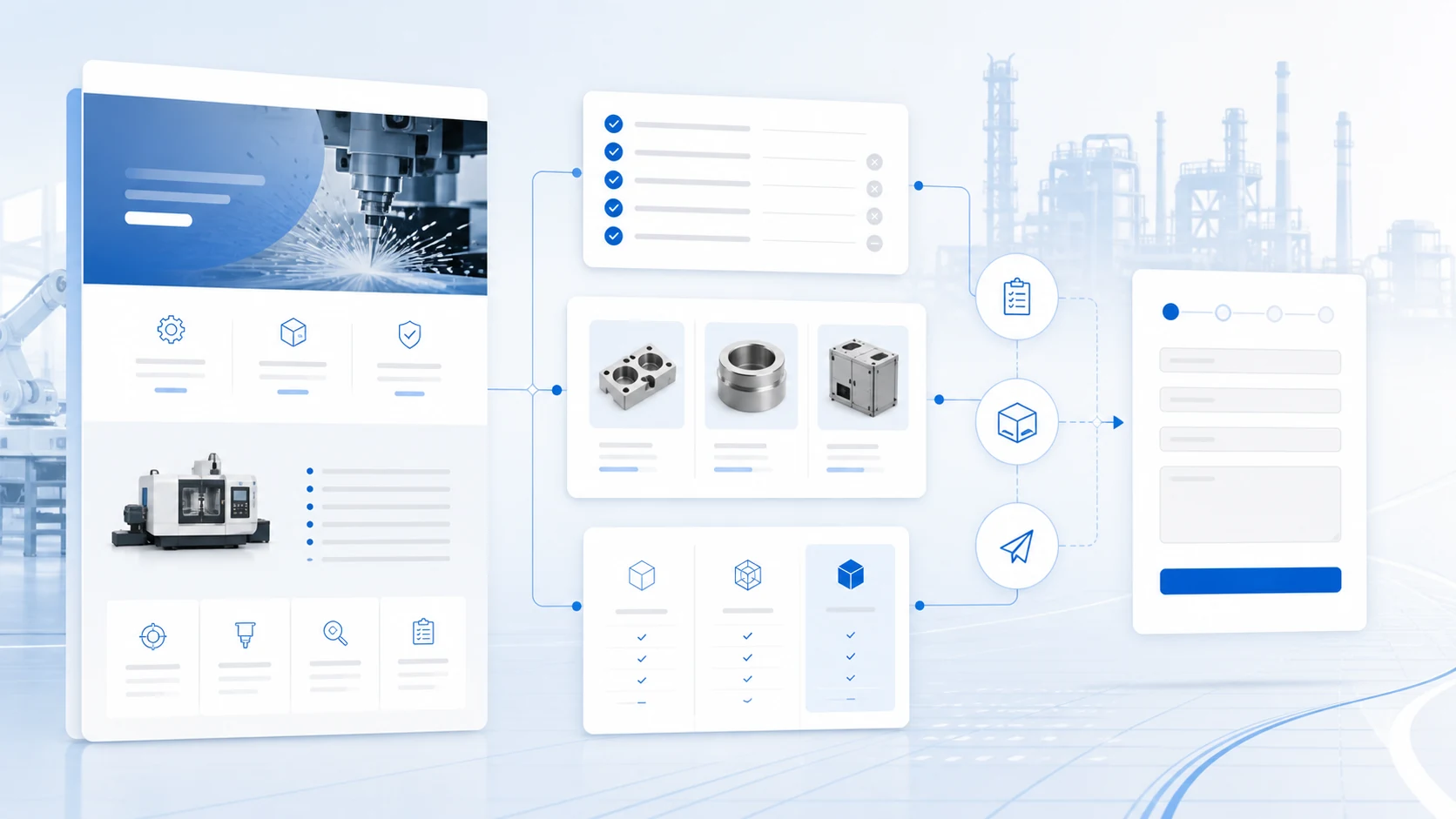
A clearer approach is to break delivery into checkable items: page structure, first-screen copy, product modules, application scenarios, trust content, form path, basic SEO settings, mobile adaptation and launch review.
Explain what is excluded
Many project disputes happen because the client assumes some work is included by default. Translation, product photography, video editing, ad management, server setup, long-term content updates and third-party publishing should all be clarified.
Exclusions are not refusals. They simply separate optional work so that scope, timing and cost can be confirmed when needed.
- Are product materials, images and video assets included?
- Is English or multilingual rewriting included?
- Are ad accounts, tracking and optimization included?
- Are maintenance, content updates and testing included after launch?
List what the client should prepare
The quality of an industrial landing page depends heavily on source materials. Product parameters, application industries, common questions, pricing logic, delivery cycle, inspection standards, photos and videos all affect the final page.
A preparation checklist helps the client know what to collect before consultation. It also makes the service process feel more professional and efficient.
Make pricing factors transparent
Landing page pricing is usually affected by page count, design complexity, content preparation, language versions, media assets, form functions, tracking setup and hosting environment. If the work includes website building, reference pricing such as RMB 6,000 and up for template websites over three years, or RMB 15,000 and up for custom websites over three years, should be tied to scope.
For single-page promotional design, RMB 300 per page can be used as a reference. Printed catalogues or samples should be priced based on demand. Pricing transparency helps buyers judge fit; it should not be presented as a promise of fixed results.
Give a clear next step
A landing page is not a contract page. After explaining service boundaries, it should guide buyers to a simple next step: share the current website, product materials, target market and the problem they want to solve.
Hulian Leading Technology reviews topic focus, internal links, mobile layout, forms, SEO titles and descriptions, and follow-up content paths when planning landing pages, so that a new page does not become an isolated URL.
- Link to the relevant service page and contact page.
- Add related insights as further reading.
- Keep sitemap and structured data aligned.
- Update FAQ and internal links from real inquiries after launch.