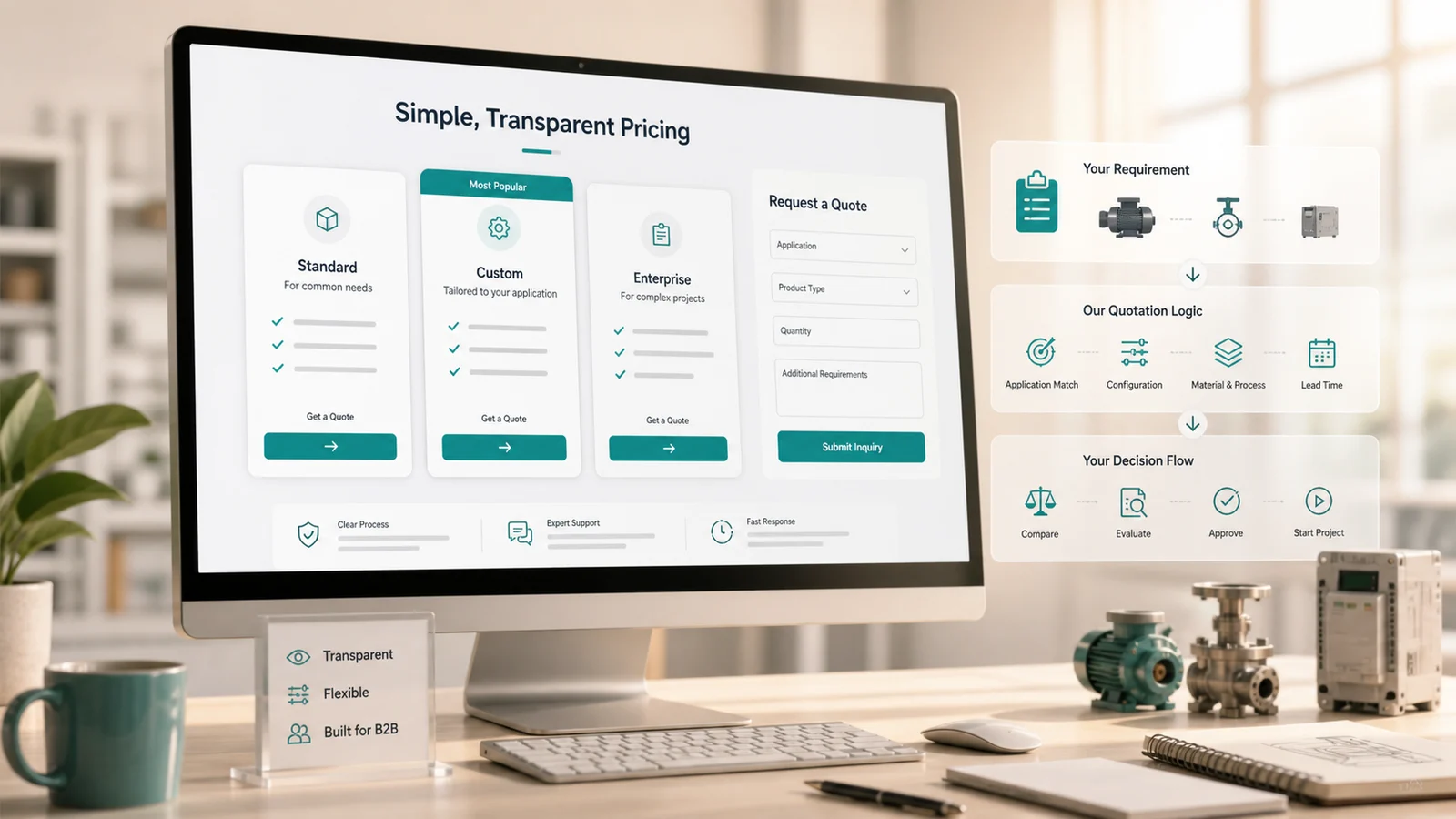
Vague pricing is not always safer
Many manufacturers hesitate to show pricing on landing pages because buyers may compare numbers directly, and many industrial products need custom quotes based on specifications, materials, lead time and configuration. That concern is valid, but hiding pricing completely creates another problem: buyers cannot judge whether the budget range fits.
Pricing on a landing page does not need to be the final contract price. It should work as a qualification tool that explains where the project starts, what is included and what factors may change the final quote.
Start with the billing unit
Pricing becomes easier to understand when the billing unit is clear. For industrial products, websites, videos and PPT materials, a single total price rarely explains how many pages, minutes, years or deliverables are included.
For example, a template website can be stated as “from RMB 6,000 / 3 years,” PPT design as “RMB 200 / page,” and a corporate film as “RMB 8,000–15,000 / minute.” These are not fixed outcome promises; they help buyers understand how the quote is calculated.
- Per page: suitable for PPTs, single-page flyers, parameter pages and visual materials.
- Per minute: suitable for corporate films, video editing and animation content.
- Per year: suitable for websites, SSL certificates, SEO or AI GEO retainers.
- Per project: suitable for custom websites, landing pages and integrated growth projects.
Place included scope next to the price
A pricing card should not show only the amount. Buyers need to know what the price includes, what it excludes and whether additional costs may appear later.
For an industrial short video service, for example, the page can explain that the starting package includes 80 scripts, editing and RMB 5,000 media spend allocation. This is clearer than showing only a package number, and it reduces low-quality inquiries.
Explain quote variables directly
Industrial projects usually involve several variables. A landing page can list quote factors before the buyer contacts you, which improves transparency and guides the buyer to submit more complete information.
- Product model, specification, material, process and customization level.
- Page count, language versions, integrations and content preparation workload.
- Shooting location, duration, script complexity, editing and animation requirements.
- Target market, keyword competition, budget period and landing page readiness.
Keep pricing separate from outcome promises
Pricing should not be mixed with guaranteed results. For SEO, AI GEO, Google Ads and paid video promotion, the page can describe service scope, but it should not promise fixed rankings, fixed inquiry volume, fixed ad returns or guaranteed AI recommendations.
A safer expression is to describe which conditions the service improves, such as content structure, landing page conversion, ad testing, search readability and sales communication materials. Actual outcomes still depend on products, market demand, competition and execution.
Pricing section checklist
Before publishing, review the pricing block with a short checklist. The section does not need to be long, but buyers should understand what information to provide next.
- Does it state the starting price, billing unit and applicable scope?
- Does it explain what the base package includes and excludes?
- Does it list the main factors that affect the final quote?
- Does it provide a clear inquiry path and requirement prompt?
- Does it remove promises of rankings, inquiries, ad returns or AI recommendations?