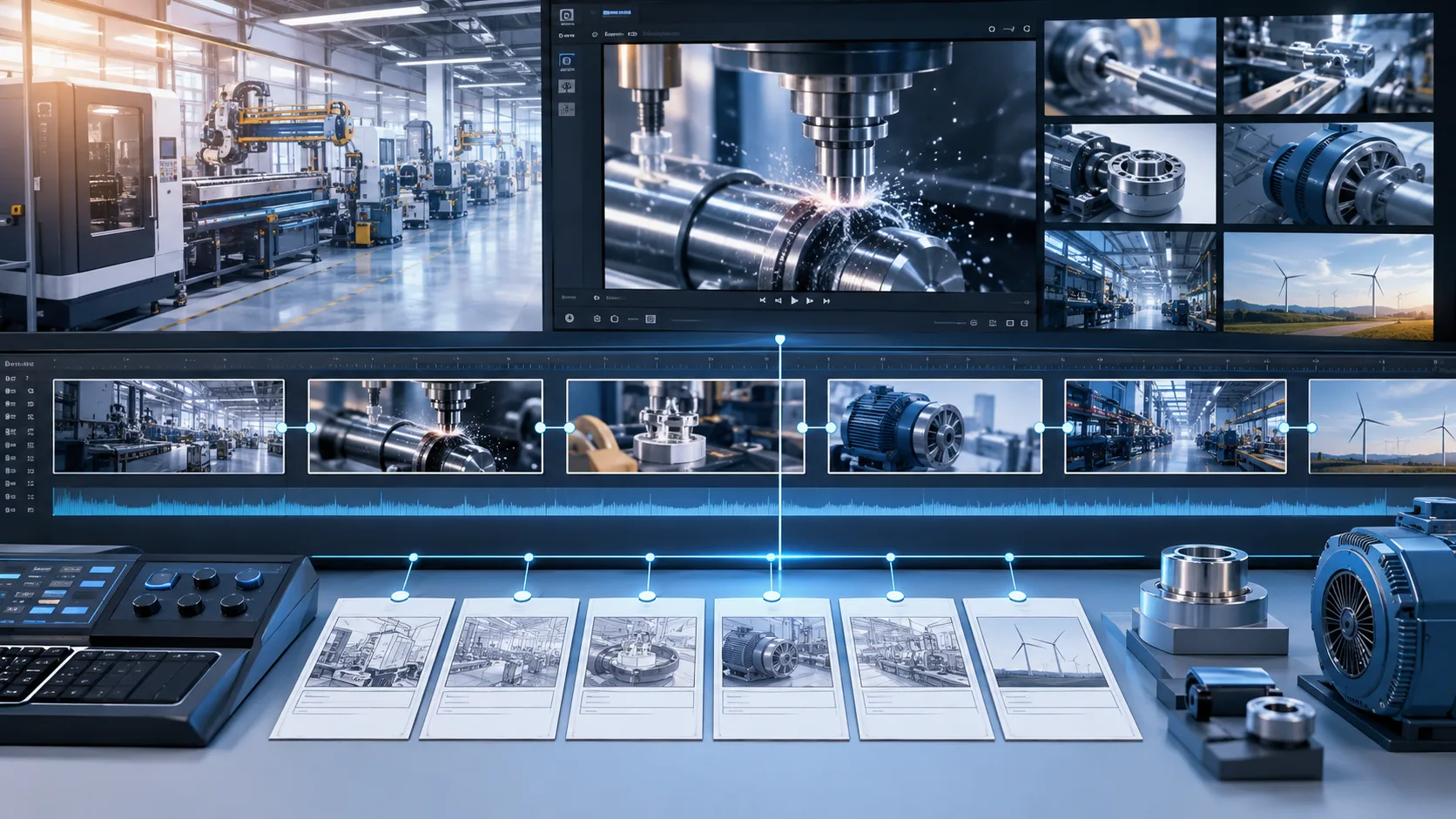
Make rhythm serve understanding
Many manufacturing videos look busy, but buyers remember only drone shots, workshops and slogans. They still do not understand what the company solves. The issue is often not the footage, but the editing rhythm.
Industrial buyers care about product fit, process stability, delivery reliability and clear communication. The video should let these signals appear in a logical order instead of spreading all footage evenly.
- Open with company positioning and core business.
- Use the middle section for factory, equipment, process and product details.
- Use the later section for applications, service flow and cooperation path.
- End with a clear contact path without exaggerated promises.
Open faster, then slow down for details
The first 15 seconds should help buyers identify the company, product category and suitable customer. This part can move faster with a few strong visual signals.
When the video reaches products and processes, the rhythm should slow down. Key equipment, testing, operation details and applications need enough time on screen, otherwise buyers cannot see the real value.
Arrange shots by decision logic
An industrial corporate video should not simply follow shooting order. A more useful order is company overview, production capability, product structure, process flow, quality control, application scenarios and service support.
When there is a lot of footage, create a storyboard or shot list first. Every shot should have an information task. Beautiful shots without a task may not belong in the main film.
- Capability shots build basic trust.
- Product shots explain structure and differences.
- Process shots explain stability and workflow.
- Application shots help buyers imagine usage.
- Service shots guide buyers toward inquiry and cooperation.
Music and captions should not block information
Music can support emotion, but it cannot replace information. If the music is too heavy, transitions are too frequent, or captions are too dense, buyers may miss the product and process details.
Captions should highlight key points, not copy the full voiceover. Use on-screen text for parameters, applications and process nodes, and reduce long slogans.
Prepare channel-specific versions
A corporate video may be used on the website, at exhibitions, in sales meetings, on WeChat Channels, Toutiao, Baijiahao and overseas social platforms. Each channel needs a different duration and rhythm.
Keep a full version, website version, exhibition loop and social short version. Corporate video reference pricing is RMB 8,000–15,000 per minute, depending on script, filming days, locations, editing package and deliverable versions. 3D animation or VR work is usually evaluated separately at RMB 400–800 per second.
Use a material checklist before editing
Classifying footage by information task before editing is more efficient than dropping everything directly into a timeline. It reduces repetition and prevents important product or process details from being pushed aside by decorative shots.
- Is company positioning clear in both image and wording?
- Do core products have detail, operation and application shots?
- Do key processes have enough visual explanation time?
- Are quality, delivery and service signals visible?
- Do website, service and insight pages provide internal links?
- Are final versions suitable for horizontal, short-form and sales use?