Do not turn the PPT into a document warehouse
Many industrial sales decks do not lack information. They lack a decision path. Product photos, parameter tables, company introductions and scattered proof points may all be useful, but buyers still need to know which page helps them make a decision.
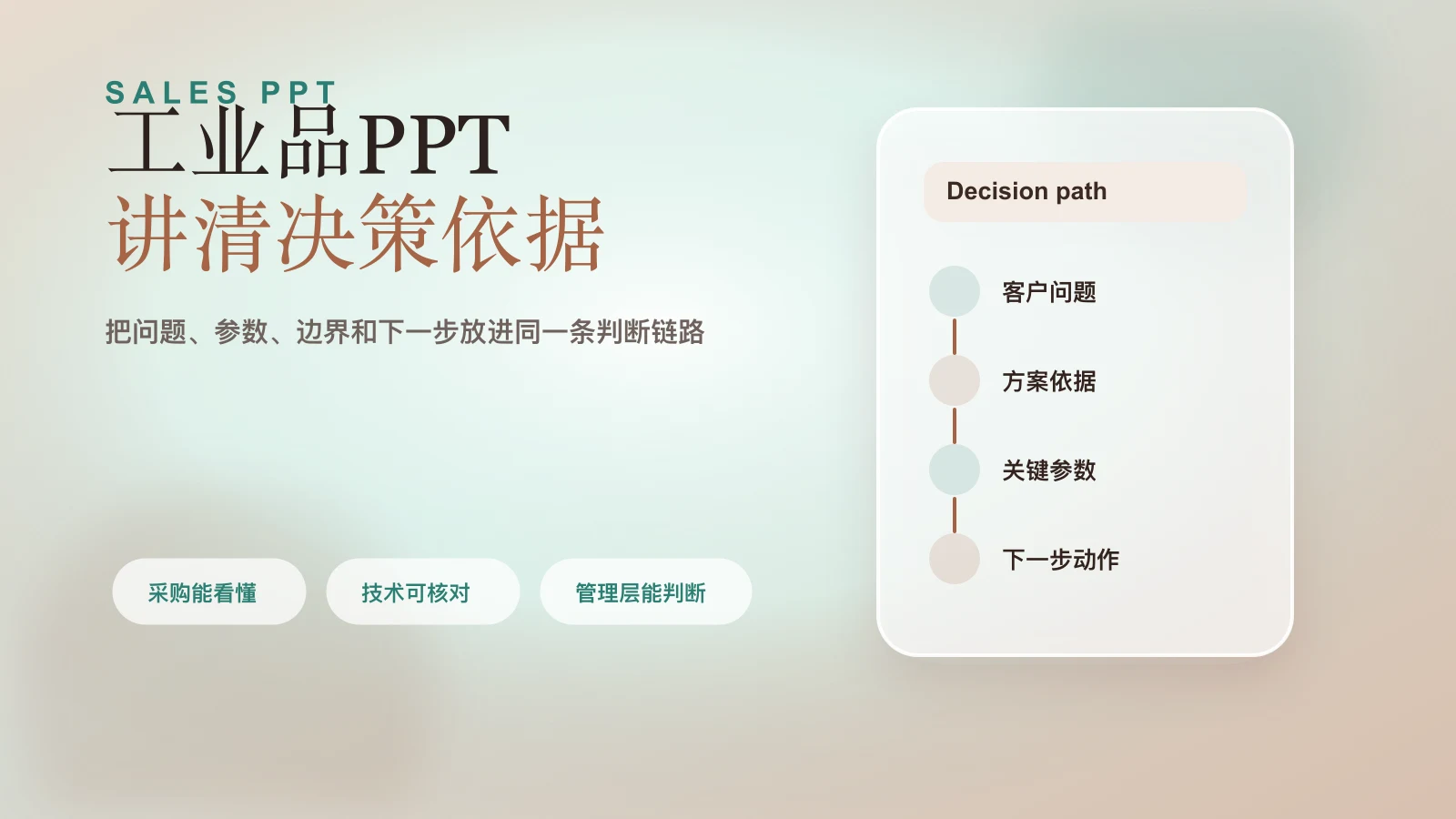
A better sales PPT starts with the buyer’s problem, explains why the proposed direction may fit, shows which parameters matter, states what still needs to be confirmed, and ends with a clear next step.
Separate the decision roles
One industrial PPT may be read by purchasing, technical and management teams at the same time. Purchasing teams care about supply scope, delivery and communication. Technical teams care about parameters, operating conditions and risks. Management teams care about whether the project is worth further attention.
The deck should not serve only one role. The opening can explain the business problem, parameter pages can support technical review, solution pages can support management review, and the final pages can help purchasing start the next conversation.
- Purchasing needs scope, delivery and a clear contact path.
- Technical readers need parameters, conditions and source information.
- Management needs value, boundaries and the effort required for the next decision.
- Sales teams need a flexible order that follows customer questions.
Parameter pages should explain the reasoning
A parameter table is not enough by itself. Useful industrial PPTs explain which parameters affect selection, efficiency, safety, cost or delivery, and what information the buyer must provide before a recommendation can be confirmed.
If certain values depend on materials, operating conditions, target markets or testing, the deck should say so. This makes the proposal more professional and reduces the risk of one-size-fits-all expectations.
Make the scope and limits visible
A sales deck should not only list strengths. It should also show the conditions under which the solution is suitable. Boundaries do not weaken persuasion; they help buyers understand when it is worth continuing the conversation.
Equipment, websites, advertising and content projects can all be affected by materials, budget, market, documentation quality and team coordination. Explaining these factors early can reduce misunderstanding later.
Review the deck before delivery
Before sending the PPT, review it from the buyer’s reading path. The key question is not how many pages the deck has, but whether the buyer can understand the problem, the proposed direction, the evidence, the remaining questions and the next action.
- Does the first page explain the customer problem and proposal direction?
- Is the page order based on buyer decisions rather than company self-introduction?
- Are parameters, visuals and processes explained instead of only displayed?
- Have unverifiable clients, rankings, results and data been removed?
- Is the next step and contact path clear?
- Is an editable version available for project-specific updates?